
My BMW Saga 2 – Jesus Scolds me About Harleys

Jesus?

Lightning struck the mountains with a loud peal and thunder rumbled between the valleys.

I’m here.

Thank God.

Really?

Sorry, I wasn’t trying to be a smartass.

How can I help you?

I’m tired of messing up with motorcycles. For the last, I dunno, ten years maybe? I just don’t get the same satisfaction I used to get from a Harley.

And why do you think that is?

I haven’t got a clue, man, I used –sorry. I used to love the whole Harley experience, face in the wind, that 21″ chrome wheel slicing through the air ahead of me, that beautifully shaped tank.

There truly is nothing like a Harley. Even the lousy suspension was a treat. So long as you didn’t hit something big, there was something smooooth about it that I just don’t feel on any other bike. Kinda like an old Cadillac.

It was special.

Yeah. So you know. Like, when you approached a curve, if you were in the right part of the powerband and released the throttle, those flimsy-ass forks would compress and the bike would just fall into the corner in the most delicious way. I mean, most riders would call that a flaw. But if you did it right, the bike kinda crouched like a Dachshund ripping around a bedpost, and then you got the unique pleasure of steering with the throttle. Like with a muscle car.

Precisely.

Hooligan central!

Are you familiar with the First Commandment?

No.

No?

Well, I know there is a First Commandment. Does that count?

No, it does not count.

OK, so help a brother out.

Thou shalt have no other gods before me.

Oh. That one.

Do you think it applies here?

I dunno. It’s not like I worship my Harleys or anything!

Are you being honest?

I sighed. OK. So, like, if I’m feeling down or weird or whatever, I go look at the Softail parked out back and I immediately feel better. But that’s not like, worship is it?
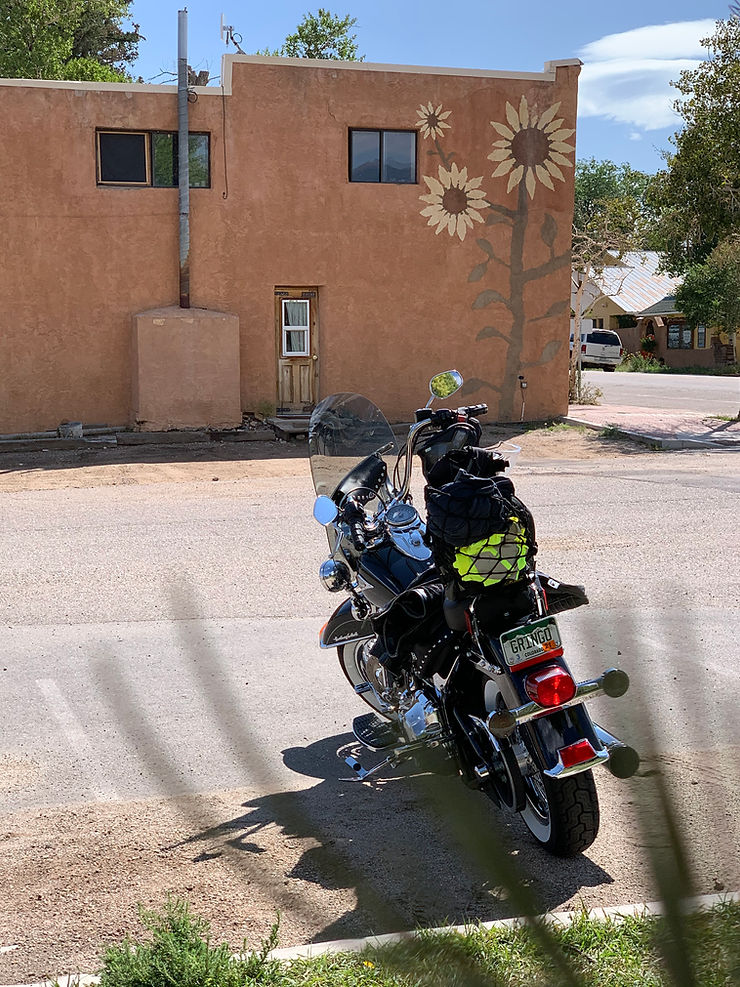
Close enough that it replaces the worship you should be doing.

No offense, but have you ever owned a Harley?

What do you think?

Oh. Sorry. I’m kinda new to this.

It shows.

OK, let me try again. You’re like God and everything. But you’re … well, way up there. I can’t see you. I can’t touch you. I can’t wash you down with McGuires carwash on a warm afternoon and clean your spokes and wax your paint until it shines like the sun.

(Photo courtesy of Billy Sharp.)

And to be honest, a lot of the time –most of the time, actually– you feel so far away. It’s easy for people to claim you don’t exist because, well, it’s hard to find evidence that you do.

Why do you think that is?

Not a clue, Jesus.

Lightning struck the mountains with a loud peal and thunder rumbled about the valleys.

Daaaang. Does that happen every time I say your name?

While I’m visiting.

So if I simply say “Jesus …”

Lightning struck the mountains with a loud peal and thunder rumbled about the valleys.

Jesus.

Lightning struck the mountains with a loud peal and thunder rumbled about the valleys.

Jesus.

Lightning struck the mountains with a loud peal and thunder rumbled about the valleys.

That is so much fun!

What brought me to you this time?

I was kinda, well, begging for help.

You were praying.

Is that what it was?

It was not a very good prayer, but we cut beginners some slack. So why’d you pray?

Because the motorcycles weren’t doing it for me.

Just like Scripture says, right?

I guess.

If you’d read your Bible, you’d eventually stumble upon Isaiah 55:2:

Why do you spend money for what is not bread,
And your wages for what does not satisfy?

I guess I’ve been doing that, huh? I’m sorry.

If you truly were sorry, you’d try to do better. You would resolve to practice praying until you could feel my presence as certainly as you feel the presence of the Harley in your garage.

To be honest, Jesus, praying looks like a drag.

Lightning struck the mountains with a loud peal and thunder rumbled about the valleys.

Sorry. Not sorry. That is so cool! But my point is, like, have you been to church lately?

Jesus said nothing.

OK. Dumb question. But everybody seems depressed. They mumble things they don’t mean and yech, it’s a drag all around.

…these people draw near with their mouths and honor Me with their lips, but have removed their hearts far from Me…

Wow! So God said that?

Technically Isaiah, but yes.

So you see what I mean? Why couldn’t blasting down that road in Yellowstone with Wagner blasting in my ears count as prayer, instead? I mean, wouldn’t that be a cooler prayer than me mumbling stuff I don’t mean in big dark building?

Flight of the Valkyries.

Yes! Did you see Apocalypse Now?

Are you really asking me that?

Playing Wagner while riding my Harley down that road, the revs rising and falling, the curves, the mountains. It feels like prayer. Only I’m not asking for anything. I’m just digging it.


That’s what worship is supposed to feel like.

No way!

As it says in Psalm 98:

Make a joyful noise unto the LORD, all the earth:
Make a loud noise, and rejoice, and sing praise.

Wow! So the Bible does get loud pipes! So why can’t riding my Harley be a prayer?

Have you read Ecclesiastes?

I denied myself nothing my eyes desired;
    I refused my heart no pleasure.
My heart took delight in all my labor,
    and this was the reward for all my toil.
Yet when I surveyed all that my hands had done
    and what I had toiled to achieve,
everything was meaningless, a chasing after the wind;
    nothing was gained under the sun.

Damn. That’s kinda how I feel around my Harleys, now. It really sucks, Jesus.

Lightning struck the mountains with a loud peal and thunder rumbled about the valleys.

Sorry. Sorry. I didn’t do that one one on purpose.

I know.

I’ve tried other bikes, you know. I go out and buy a BMW. Or a Ducati. And a coupla Hondas. I even tried a KTM!


And what happens?

I like them at first.

But?

But then they fail to satisfy.

Why do you think that is?

Because they’re not a Harley.

Aren’t you tired of the bugs in your teeth? The short-shifting? Your pegs grinding in the corners?

No.

Seeking lower companionship?


Now wait a sec. Bhro’s an alright guy.

Jesus smiled.

Your sense of humor is rather wicked at times, isn’t it?

Do you think we don’t laugh in Heaven?

Um … no.

Why not?

There’s not a single joke in the Bible. Not one.

And yet, Psalm 118:

This is the day the Lord has made;
We will rejoice and be glad in it.

Not exactly Comedy Central material, is it?

I’ll give you that, but we do laugh in Heaven. A lot. Now, what did I say about change?

Um … Um …

Go to Isaiah 48:10.

OK. Gimme a sec … um … just a–

It’s after Kings.

I knew that.

Stop lying.

Sorry.

I said, “Stop Lying.”

I grimaced. I dug through my bible. Daaaang. That’s a lot of chapters. This dude WROTE. OK, I’m there.

Behold, I have refined you.

Because you are mine, what used to satisfy the old you does not satisfy the new you.

But I see plenty of guys with Christian colors riding Harleys!
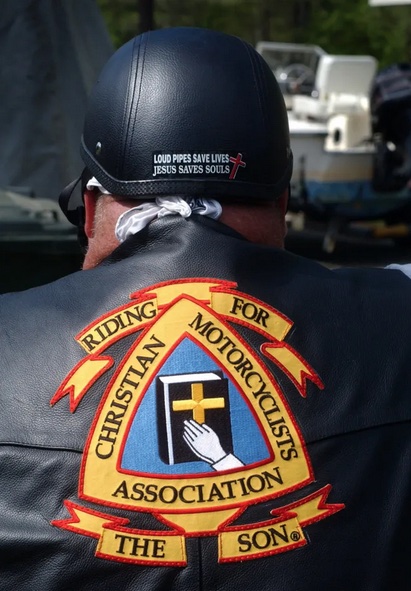
That’s fine for them. They have their walk with God. You have yours.

Sheesh. Preacher didn’t tell me THAT would happen when I got baptized.

No matter how many you keep buying, no matter which model you buy, you won’t be satisfied any more.

Like Ecclesiastes, Huh?

Yes.

So what am I ‘sposed to do, then?

Allow me to renew your mind.

Wha … what are you gonna do to me? Wait. You’re not gonna make me like BMW’s are you?

That’s exactly what I want you to do.

Noooo! BMWs lack the chrome and the purty colors on Harleys. And metal flake. And pin stripes! I can’t imagine loving a BMW like I used to love my Harley.

You will once you do the will of your Father who is in Heaven.

I’m gonna be depressed like the dude who wrote Ecclesiastes, aren’t I?

Not if you do the will of your Father who is in Heaven.

Why do you always say it like that?

It makes him grin.

I hang my head.

Go out and get a BMW. Learn to enjoy it.

You’re asking me to do what you asked Abraham to do, you know. Kill his own son.

And how did that turn out?

OK. You have a point. But how do you know I’m not gonna love my BMW as much as I loved my Harleys and we have to go through all this all over again?

Won’t happen.

Yeah? Why?

It’s not a Harley.
Judging Other Faiths

Photo of mosque in Medina by my riding buddy Mo

I am not an expert in world religions. I’m not even knowledgeable. I’m just curious. This post is an attempt to understand something by writing about it, not an authoritative explanation of anything.

John 16:4 has both comforted and troubled me:

I am the way, the truth, and the light. No one comes to the Father except through me.

It has comforted me because that’s been my experience. For decades I tried having a relationship with God without Jesus. I prayed to God. I meditated. I was part of several 12-step spiritual communities. Although it helped, it did not come close to what happened after I accepted the love of Jesus. I was suddenly listening to the 1812 Overture from inside Carnegie Hall, and the past sounded like the Beach Boys through a transistor radio from the 1960’s.

It has troubled me because some Christians interpret it to mean that other religions are inferior or just plain invalid. Some go so far as to claim that if you are anything but a Christian, you will burn in fire for all eternity.

I can’t bring myself to share that opinion. It seems rather un-Christian. After all, the second greatest commandment instructs us to love our neighbors as ourselves. Would a God that wants us to love our neighbors not do the same, but instead condemn them to everlasting agony for not making the choice I made? For, perhaps, already being so devoted to their religion that it would feel disloyal or immoral to consider another?

Even Paul points out that non-Jews with a conscience are better people than Jews who know the law but break it anyway. In Romans 2:14 he contrasts them to good Gentiles:

For when the Gentiles, which have not the law, do by nature the things contained in the law … show the work of the law written in their hearts, their conscience also bearing witness …”

And what about those who have been exposed to fake, toxic versions of the Christianity I love so dearly? Romans 2:24:

Thou that makest thy boast of the law, through breaking the law dishonor thou God? For the name of God is blasphemed among the Gentiles through you …”

That passage referred to the Jews, but it’s also true of Christianity. These passages support my instinct that the purpose of John 16:4 was not to condemn other religions. But that’s just my thinking. What does the Holy Spirit tell me? I’ve prayed quite a bit about this. Prayer, to me, is pondering a question or challenge in the company of God. Or Jesus. Sometimes I pray to one, sometimes to the other. Even though they are the same. Don’t ask me to unravel that mystery; I hardly understand it, myself. But I can work with it. When I pray to God about this issue, the first thing that comes to me is a warning about spiritual pride. It’s just too easy to use that part of Scripture to fool myself with a false certainty: I am Christian, so I am right. I am saved. And you’re not.

In Colossians 3:12 Paul points gives us some guidance that I find helpful here:

Put on therefore, as the elect of God, holy and beloved, bowels of mercies, kindness, humbleness of mind, meekness, longsuffering.

Humbleness of mind. To me, that means remain teachable. Be certain of the love of Jesus in your heart, but don’t be too certain of what your brain thinks it knows about other things. When I approach John 16:4 in that spirit, I wonder about the context in which Jesus spoke those words. Was he comparing himself to Islam? Of course not. Muhammad founded Islam about 600 years after the death and resurrection of Jesus. Did the Jews at that time know about Hinduism? Buddhism? Probably not. So Jesus was probably comparing himself to the false gods of the time, such as wealth, fame, power, influence, and so on. Even more than these, I suspect he was referring to the hypocritical practitioners of righteousness who had become so powerful in his own faith.

However, I’m also wary of twisting His words to mean something they were never intended to mean. Whether well-meaning or evil, a false teacher is still a false teacher.

So what am I ‘sposed to do?

A man once told me it can sometimes be just as valuable to stay with a question as to get an answer. In that spirit, I’ve been doing a little reading.

The guy who took the picture of the mosque up top, Mo, prayed for me in that very mosque last year. So I’ll start with a total amateur’s understanding of Islam. According to the Islam Scholars at Harvard, spiritual transformation for a Muslim is the result of four actions:

  1. Certainty in faith
  2. Ethical practice in all spheres of behavior
  3. Liberation and discipline of the conscious
  4. Demonstrating the best and most virtuous action for a given moment.

While on a ride last Saturday, I asked Jagdish, a Hindu riding buddy, about Hinduism. He explained that Hindus believe there are paths you can take toward enlightenment. Unlike the four actions of Islam that are performed in sequence, a practitioner can take any of these actions independently of the others.

  1. The path of selfless action (Karma Yoga) – Act not with selfish motives, but with love and as an offering to God.
  2. Path of devotion (Bhakti Yoga) – Surrender yourself to God through love, prayer, and devotion.
  3. Path of knowledge (Jnana Yoga) – Study sacred texts and yourself to gain knowledge and wisdom, and understand the true nature of life.
  4. Path of meditation (Raja Yoga) – Achieve inner peace and connect with the divine through the practice of meditation and self-control.

Judaism does not seek specific actions or paths to enlightenment, but relies rather on a life of living righteously. You do that through practices such as these:

  1. Obey God’s commandments.
  2. Seek God and align your will with His.
  3. Repent after doing wrong.
  4. Act with compassion, be generous, and fight to bring about a more just world for all people.
  5. Study the Torah and be sincere in your devotions.

Anyway, still speaking from ignorance but with a lot of curiosity, I get the impression that those religions, and perhaps others, are designed for good people. Practitioners achieve righteousness through their own efforts. That seems mighty fair to me: you do the work, you get the results. Unfortunately, that isn’t a good formula for sinners. After all, righteousness requires discipline, focus, reliability, introspection, resilience, and other qualities that sinners tend not to have in abundance. Take your average alcoholic, drug addict, high school drop-out, petty criminal, and so on, overlay a Venn diagram with the qualities of the righteous, and you probably get zero overlap.

So what’s a sinner to do?

I have not come to call the righteous, but sinners to repentance.
– Luke 5:32.

And be found in Him, not having mine own righteousness, which is of the law, but that which is through the faith of Christ…”
– Phillipians 3:9

Trust in the Lord with all your heart and lean not on your own understanding; in all your ways submit to him, and he will make your paths straight.
– Proverbs 3:5

Technically, Proverbs is Jewish, but I find that overlap kinda cool.

Bottom line, Jesus transforms a sinner into someone who loves. The practice of Christianity is not about achieving righteousness so that I may be worthy of God’s acceptance or somehow achieve superiority over others in an afterlife. Christianity has absolutely nothing to do with my value or worth. Instead, I simply realize how abundantly I am loved. And it is out of that love, because of that love, that I become, not righteous, but transformed. Once more, Jesus’s instruction is crystal clear on this matter. Matthew 22:37-40:

… Thou shalt love the Lord thy God with all thy heart, and with all thy soul, and with all thy mind. This is the first and great commandment. And the second is like unto it, Thou shalt love thy neighbor as thyself. On these two commandments hang all the law and the prophets.

Love. Not righteousness. Or discipline. Or ethical practices. Or devotions. Love. That’s what Christianity is supposed to be about. Righteousness, discipline, devotion, and other laudable qualities follow once the love is there. But they begin with the love from God, then the love of God, followed by the love of neighbor.

And so, on this matter I’ve come to a few conclusions. For now. Because I’ll keep praying about this, trying to understand it spiritually.

  1. If Jesus came to for the sinners, I should be grateful to be a Christian, not prideful. After all, saying I’m a Christian is also saying I was a sinner who could only be redeemed by the love and power of Jesus. And if it was Jesus himself who transformed me, then what have I got to brag about?
  2. In that spirit of humility, I am called to treat practitioners of other faiths (or no faith at all) with respect. Perhaps they are, indeed, the righteous. Perhaps they did reach a degree of holiness through their own efforts, something I was unable or unwilling to do. Perhaps they have “the law” in their very nature, as Paul suggests.
  3. I will continue to pray to what I believe is The One True God (in his three manifestations, Father, Son, and Holy Spirit), but I will also love my Muslim, Jew, Hindu and Buddhist neighbors as they pray to what they believe is the One True God.

Freeing Myself from the Bondage of Skepticism

A bench in Aspen, Colorado. My picture.

I spent most of my life as a skeptic. I thought it was the right thing to do. It was simply irresponsible to believe something that could not be proven beyond a reasonable doubt. While telling us about her Ph.D program at Oxford, a philosophy professor I admired told us a story about the lecturer who welcomed her particular class. He announced, in an impeccable English accent, that the entire objective of their doctoral program would be to learn “how to identify rot.” That impressed me as a great way to live, identifying rot. But that’s not the only reason I became a skeptic.

I’d grown up with a lot of redirecting, obfuscating, deception, and flat out lies. From the earliest age I can remember, I didn’t know who to believe. Nobody let anyone know what they were really feeling because that would give others an angle of attack, a handle to manipulate. I learned to suspect you, me, and anybody who tried to get close to me.

That skepticism came in handy at first. In the old school version of high tech, before offshoring and agile computing and productivity tools (and now artificial intelligence) plus plain old greed ruined what had once been a respectable profession, skepticism was indispensable. It made you take extra care about what you said and the work you delivered. For the simple reason that you had to be able to back it up. If you’ve ever worked with Solaris kernel engineers, you know what I’m talking about.

Nevertheless, what served a good purpose at work left me adrift the rest of the time. No matter how much success I experienced, I was unsatisfied. Some stupid notion that snuck into my brain without my permission told me that getting no satisfaction from life was not actually the problem, but the very trait that enabled the advancement of the human race.

The only problem with that logic is that it left me in a State of Suck. Good for civilization? Maybe. Good for me? Nope. Not sure if it’s the same for others, but by finding fault in everything, and dismissing anything that has a fault, I wound up valuing nothing. Because nothing on Earth is perfect. Everything has faults.

So, while others were finding solace, comfort, guidance, strength, and so on from a faith that I cavalierly discredited as mysticism, mass delusion, guilt trips, fire insurance, and whatnot, I was receiving only emptiness from the skepticism I so highly valued. I was left in a perpetual state of simply not knowing.

I tried lots of things to fix it. Work harder, do more, succeed more. Please more people to gain more respect. Try something new, and succeed at it. Re-read Carlos Castañeda. Read P.D. Ouspensky and other obscure authors that supposedly held the key to enlightenment. Read everything Ayn Rand wrote. I mean e v e r y t h i n g. Exercise more. Exercise a lot more.

None of it worked. It just distracted me for a while.

All around me, Christians were claiming peace, security, joy, contentment. Of course I didn’t believe. I thought they were full of shit. Though I had experienced a compelling but very private conversion to Christianity in my early 20’s, my skepticism had drawn me away from it. And there were so very many examples of Christians living anything but Christian lives.

Besides, Skepticism made it abundantly clear that the most fundamental logic of Christianity, that “the only begotten son of God” was crucified to atone for the sins of the world, was at best a medieval fable and at worst an outlandish example of bad marketing. Anybody in their right mind would see right through it!

Except those pesky Christians, of course. They claimed it was a fact.

“How is it even possible that you believe that?” I practically shouted at them.

They responded with circular logic: “If you believe, you will understand. If you don’t believe, you won’t.”

To a skeptic, this kind of logic is simply too easy to refute. It’s madness. Funny enough, the Bible agrees. This is the first part of 1 Corinthians 2:14 (King James version) …

But the natural man receiveth not the things of the Spirit of God, for they are foolishness unto him;

Before I bought my first Harley, I would ask Harley riders what they liked about that slow-ass ancient pile of old-school iron and chrome. They’d answer …

“If you have to ask, you wouldn’t understand.”

I scoffed at that answer until I bought my first Harley.

If you use the wrong faculty, you’ll fail to appreciate Harleys. To any motorcyclist who values price/performance and other logical metrics, Harleys “are foolishness unto him.” But to some of us they are the Deep Truth of motorcycling. And we have a helluva time explaining why. (If, however, you want some insight into why someone like me can love Harleys so much, mosey on over to Ride to the Sun Reunion.)

But the infuriating logic was the same for Christianity as it was for Harleys: if you feel it, you know. If you don’t feel it, it’s foolishness.

Exactly what happened that that led me back to Christianity?

Fire Insurance!

A classic reason for becoming a Christian. Just in case. I mean, horror of horrors, what if they are right?

Problem is, being a fake Christian sucks. You gotta sit through sermons while your brain screams “this is bullshit!” at you. You gotta hang out with people you highly suspect to be delusional, and utter pleasantries that makes your skeptic stomach curl into a knot. You gotta join Church activities that you don’t believe in. You gotta tithe. On top of paying taxes!

If you are a true skeptic, you won’t tolerate that amount of bullshit. You simply can’t.

You are getting soft in your old age!

Well, that’s a reasonable assumption. Staying true to your values is hard work. You get old, you get tired, you start slipping. Pretty soon you just start going with the flow. It’s easier.

Two problems with that assumption. The first is that Christianity demands a lot from a man. There’s nothing about it, that I know of, anyway, that tells me to drop my standards. It’s actually the opposite. For instance, Matthew 22:33-40 describes the answer Jesus gave to a question by one of the Sadducees …

36 Master, which is the great commandment in the law?

37 Jesus said unto him, Thou shalt love the Lord thy God with all thy heart, and with all thy soul, and with all thy mind.

38 This is the first and great commandment.

39 And the second is like unto it, Thou shalt love thy neighbour as thyself.

40 On these two commandments hang all the law and the prophets.

Are you kidding me? Loving God with all of me is a tall order. Much easier to love Harleys with all of me. Burgers. Burgers are easy to love. Jumping headlong into an incoming wave. That too. But God? Whom I have never seen and with whom I have a mysterious relationship I don’t quite understand? No, that’s not slipping. That’s actually raising my game, a lot, trying to live up to only that. And let’s not even talk about the second part.

So No, becoming a Christian is not a way of backsliding or lowering your standards. It’s just the opposite.

You are just trying to belong!

That’s certainly true. Belonging is important. Since I moved around a lot in the first part of my life, I did yearn to belong. But it’s no longer a yearning. I belong to a super terrific motorcycle group named, in an affront to grammar junkies everywhere, Triangle Lone Wolves. In spite of the name, I dig the friends I have there and the activities we engage in. Best motorcycle club I’ve ever belonged to.

And I dig my neighborhood. It’s kinda small, but we gather together on Thursday nights, the men go out to dinner while the women meet for book club, we help each other out, we stop and conversate anytime we run into each other on the street.

For 35 years I’ve been going to a 12-step program, so I have a lot of friends there. Come to think of it, 12-step programs are not rich fodder or skeptics. For two simple reasons. The first is that they don’t entertain any disagreements about the nature of God. They don’t even call Him God. Instead, they refer to God as a higher power that you get to discern on your own. If mine is Thor and yours is Tinkerbell, fine. No argument. This does not leave a skeptic much room to operate.

Second thing is, they have, well, a set of steps that you follow. If you try them and you like the results, great! If you try them and you don’t, OK. Try something else. Not exactly the scientific method, but certainly empirical. And skeptics delight in empiricism.

In addition to all that, I have friends I’m still in touch with from work, from high school, and from other activities I engage in here in town. I have a bunch of friends at the Y, even though I am not currently playing ball with them due to an Achilles injury and my cancer.

Aha! It was the cancer! You chickened out! You got cancer so you went running to a church and drank their kool-aid because you were a scaredy cat. Boo-hoo! You were askiiired. Stay still while I go call the waaaaaaahhhmbulance!

Well Hell. You got me there. Tough to argue against that point. I did get baptized shortly after I got my diagnosis for bladder cancer. So it’s pretty easy to say I only became a Christian because I got cancer. I cannot disprove that assumption. If that’s what you believe, I can’t change your mind.

But what do I believe?

I did not become a Christian because I got cancer. I have been drawn to church for a long time, now. Jesus kept knocking on my door, as my pastor likes to say.

When I went out for a ride, I usually stopped at a church. Not because I wanted to walk inside, but because it had a shady parking lot where I could take a break from the heat. And here in the South, there are lots and lots of churches.

Gradually, the idea of Church got normalized in my head. Here in the South, being a Christian does not get you branded a medieval lunatic. In fact, there are so many Christians and so many churches that Christianity has the opposite problem: people join Christian communities for the wrong reasons, thereby missing the point.

Little by little I got used to conversations about faith. Little by little I became friends with more Christians. Learned what delightful people they really were. They were not like the Christians portrayed in the media. It’s not that the media hates Christians, it’s just that the media breathes, eats, and lives off scandal. A dozen men playing basketball joyfully after praying together, for instance, would not get any media outlet’s attention. Unless they shot up a school afterwards.

In time I found myself, without intending to, saying my own little prayer …

God, if you want me to return to Christianity, change my heart. Because I am incapable of changing my mind.

I did not know at the time, but it turns out that Proberbs 4:23 has something to say about the heart. For this quote, I prefer the New International Version:

23 Above all else, guard your heart,
    for everything you do flows from it.

Bible Gateway

One day, one of my basketball pals invited me to visit his Church. I went, and I fell in love with it. Head over heels. It was irrational. The feeling was overpowering, and I can’t explain it. I wept for four Sundays straight. I was so filled, so happy, so full of love that I didn’t know what to do with myself. Nine months later, I still don’t understand. But I never miss a Sunday. Or a Wednesday Bible study. Or a church event.

Appeals to emotion are cons. You’ve been conned! And you know better!

You are now living your life by the dictates of a delusion.

If I were the victim of a delusion, that delusion would affect other parts of my daily life. But there is no evidence of that. I’m happier. More motivated. More connected than I’ve ever been. I am a Christian, now, for the very simply reason that I love the Lord dearly. In all three manifestations: Father, Son, and Holy Spirit.

And the skepticism? It’s still there. In other areas of my life, I remain skeptical. When I read the news. When I listen to political opinions. When I read a book. But no longer with my faith. As the second part of 1 Corintians 2:14 says:

But the natural man receiveth not the things of the Spirit of God: for they are foolishness unto him: neither can he know them, because they are spiritually discerned.

Is Christianity the Antidote to Cancel Culture?

Photo taken by me

Matthew 5:38-42 contains, what is to me personally, one of the most challenging instructions in the New Testament. From the King James Version:

38 Ye have heard that it hath been said, An eye for an eye, and a tooth for a tooth. 39 But I say unto you, That ye resist not evil: but whosoever shall smite thee on thy right cheek, turn to him the other also. 40 And if any man will sue thee at the law, and take away thy coat, let him have thy cloak also. 41 And whosoever shall compel thee to go a mile, go with him twain. 42 Give to him that asketh thee, and from him that would borrow of thee turn not thou away.

Bible quote courtesy of Bible Gateway.

This is not very American. You hurt us, we’ll put a boot in your ass. It feels good to imagine getting even. To talk about it and brag about it and fashion a national identity out of it. But when all the high-fiving is done, does it actually feel good to get even?

Not to a Christian, it doesn’t. Not only do we feel a vague emptiness inside, but we also know that it’s a missed opportunity for God to work miracles through us.

Let’s start with an extreme example: the Hamas murder and kidnapping of Jews in October of 2023. Surely an act as barbaric and as that is an exception to the instruction of Jesus. Surely violent retaliation is warranted in this case, right? It would certainly appear so. But examining the results of Israel’s retaliation, I wonder. As justified as the retaliation appeared, what has been the result?

Photo courtesy of AP

In spite of how justified the retaliation may have seemed, I doubt that’s what any of the victims of the initial attack would have wanted: to see even more innocents killed and their loved ones devastated.

A similar point can be made about America’s invasion of Iraq. Justified? Of course! 9-11 and all. The Christian thing to do? No, not in my humble opinion. And judging by the results, not so smart by the standards of real-world politics either, since Iraq was the only thing keeping Iran in check. A country which, in case you have not been following the dots, is a major supporter and supplier of Hamas.

The same can be said about our well-intentioned but misguided struggle about abortion. Not only has it merely resulted in temporary victories for one side or the other that are soon, or will soon be, overturned at the next election. Not only has led us farther and farther apart from each other. It has also led many away from the treasures of Christianity.

So the best I can do with these big issues is to avoid jumping to a convenient but mistaken conclusion, not look away, and focus on the things that I can actually do something about.

Now, I do not believe that the instructions of Jesus captured in Matthew require us to be locked into toxic relationships. Those hollow out the soul and leave no room for God. So they are inherently evil.

But outside of those, I believe there is a lot of room to practice not resisting evil. The evil right in front of me today is the political division that has been sowed across our country. How do I respond to what I believe are lies and manipulations being recited by a friend, family member, or neighbor? How do I respond to lifestyle choices that feel like an affront to my faith?

On the one hand, Scripture does tell us to reproach and correct each other. Luke 17:3-4:

“Pay attention to yourselves! If your brother sins, rebuke him, and if he repents, forgive him, and if he sins against you seven times in the day, and turns to you seven times, saying, ‘I repent,’ you must forgive him.”

But Romans 14:1-23 rounds out our guidance:

“As for the one who is weak in faith, welcome him, but not to quarrel over opinions. One person believes he may eat anything, while the weak person eats only vegetables. Let not the one who eats despise the one who abstains, and let not the one who abstains pass judgment on the one who eats, for God has welcomed him. Who are you to pass judgment on the servant of another? It is before his own master that he stands or falls. And he will be upheld, for the Lord is able to make him stand. One person esteems one day as better than another, while another esteems all days alike. Each one should be fully convinced in his own mind.”

Bible quotes courtesy of OpenBible.

So we are instructed to, on the one hand, reproach, but on the other forgive and tolerate. Which to apply when? Personally, I can’t know unless I pray about it. Not only because my erstwhile intellectual mind will make a Gordian Knot out an ethical dilemma such as this one, but because that constant communication with God is, as I understand it, a major point of being a Christian. “Pray without ceasing,” right?

Nevertheless, these are instructions for interacting with fellow Christians. But what about interacting with someone who is not a part of our Christian community?

Jesus tells us not to condemn or cancel that person, but to walk with them a mile. Two, actually. So the Christian thing to do in these situations is not to argue, condemn, or even try to correct the other person’s opinion. But to spend time with them. I’ve had good results with this approach lately by simply waiting for an opportunity to change the subject, then talking about something that is not divisive. Not sure how many of you remember, but before social media, that used to be the way people naturally interacted: by seeking what they had in common. “Are you a Yankees fan, too?” It resulted in joy and camaraderie.

Is this reluctance to argue a point the right thing to do ethically, politically, as a citizen of a democracy? I used to think not, but I have changed my mind. Because it has not borne good fruit. And the fruit an approach bears is how Matthew, in 7:15-20, tells us to judge false teachers:

15 Beware of false prophets, which come to you in sheep’s clothing, but inwardly they are ravening wolves. 16 Ye shall know them by their fruits. Do men gather grapes of thorns, or figs of thistles? 17 Even so every good tree bringeth forth good fruit; but a corrupt tree bringeth forth evil fruit. 18 A good tree cannot bring forth evil fruit, neither can a corrupt tree bring forth good fruit. 19 Every tree that bringeth not forth good fruit is hewn down, and cast into the fire. 20 Wherefore by their fruits ye shall know them.

Bible quotes courtesy of OpenBible.

So yeah, even the most brilliantly crafted arguments have not born good fruit in our current environment. They have only resulted in further hardening of hearts. Which leaves even less room for God. So perhaps “resisting not evil” will bear fruit. Perhaps it will soften our hearts toward each other. Lead to a little joy and camaraderie. To acceptance of our differences. And a little more room for God.